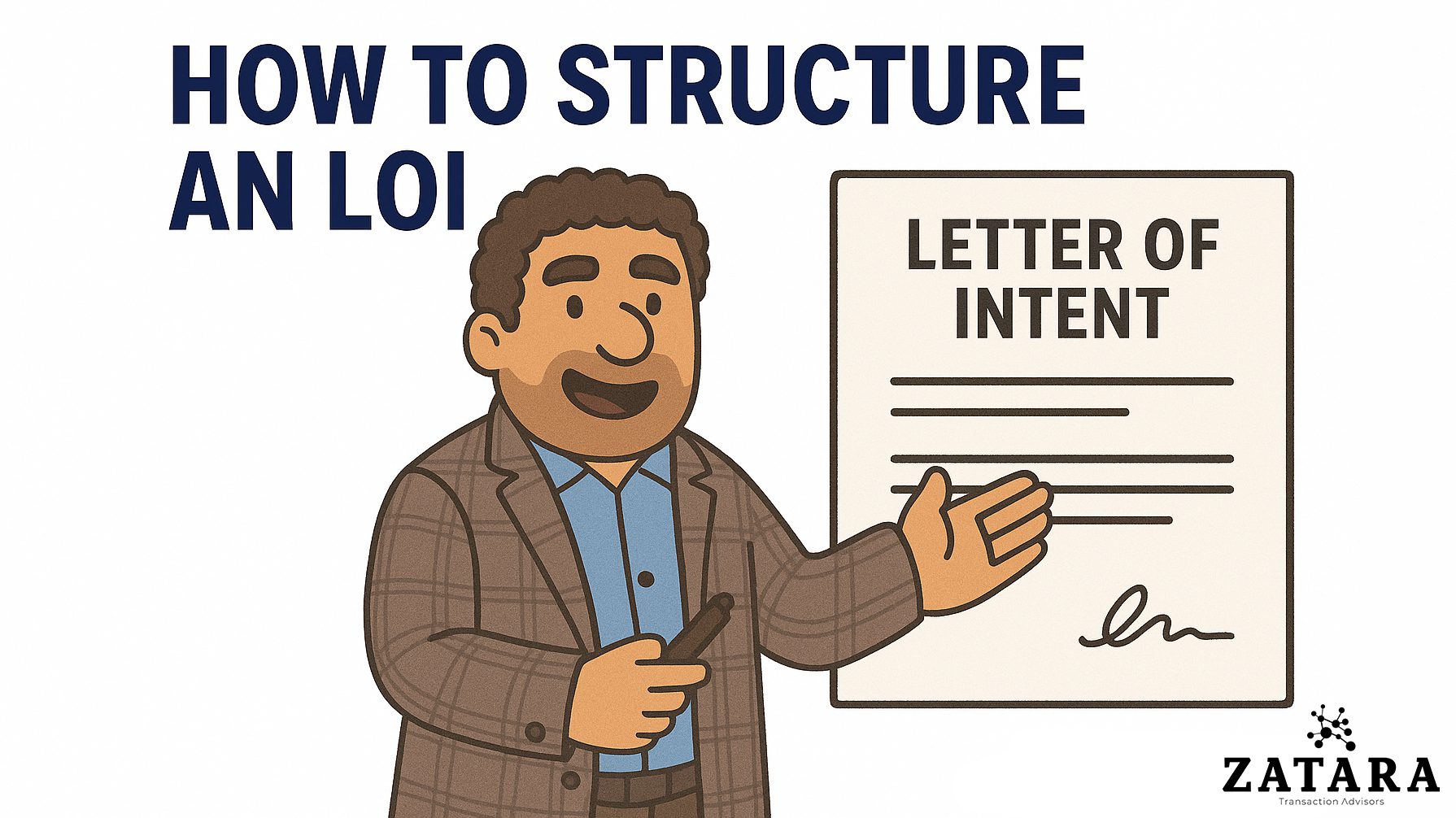
Buying a business is one of the biggest financial decisions you’ll ever make. Knowing how to structure an offer — and what a typical Letter of Intent (LOI) looks like — can save you headaches (and serious money) down the road.
Here’s a straightforward breakdown based on the LOI template we use at Zatara Transaction Advisors.
Establishing the Enterprise Value and Capital Stack
First, we determine the total enterprise value — what you believe the company is worth. Then we lay out the capital stack, which is how you’ll pay for it.
A few common components include:
- Vendor notes: This is where the seller essentially finances part of the deal. For example, you might buy a company for $1 million, but the seller agrees to finance 20% of it, which you’ll pay back over the next five years.
- Earnouts: These are additional payments tied to how the company performs after the sale. You might pay X upfront, then pay more later if the business hits certain revenue or profit benchmarks.
- Equity retention: Sometimes the seller keeps a percentage of ownership through preferred or common shares, continuing to have skin in the game.
- Cash at closing: The total amount of your cash plus borrowed funds that closes the transaction.
Timelines and Milestones
Every deal needs a clear schedule.
Your LOI should outline:
- Due diligence period: How long you’ll take to verify all the details before fully committing.
- Closing period and signing date: When the transaction is expected to wrap up.
Everyone involved — the buyer, bank, landlords, suppliers — needs to align to hit that closing date.
Key Terms and Legal Framework
A solid LOI highlights the big-ticket items up front. This might include:
- Employment agreements (if the current owner stays on temporarily)
- Non-compete and non-solicitation clauses
Then there’s the formal language: the vendor (seller) agrees to sell, you agree to buy, and your lawyer drafts the definitive agreement (asset purchase or share purchase). This replaces the LOI.
Most LOIs are non-binding except for parts such as confidentiality and exclusivity.
Purchase Price, Adjustments, and Allocation
Your LOI details:
- The purchase price, deposit, vendor note details, and the payment due at closing
- Working capital or work-in-process (WIP) adjustments, which ensure the business is handed over with the right liquidity to keep running
You’ll also allocate the price across various assets, like:
- Goodwill
- Inventory and working capital
- Furniture, fixtures, equipment
- Consulting or training agreements tied to the transition
Excluded Assets
It’s common for a business to own assets that aren’t needed for daily operations. For instance, if the owner runs personal vehicles or even farmland through the business for financing reasons, these are excluded from the sale.
Handling Vendor Notes and Earnouts
A vendor note spells out the amortization period, interest rate, amount, and security. Sellers often want to see your personal financials and credit report since they’re acting like the bank.
Earnouts get structured as installments, often tied to hitting revenue or profit targets.
Sorting Out Working Capital and Liabilities
Working capital (inventory plus short-term assets minus short-term liabilities) is something accountants love to debate. It’s best to spell it out in the LOI to avoid surprises.
Likewise, be clear on assumed liabilities. Typically, you pay off long-term debts yourself, but sometimes — if existing debt has favorable rates — it might make sense to assume it.
Employees, Conditions, and Post-Close Work
The seller usually indemnifies you against employee-related taxes and liabilities.
Standard conditions in the LOI include:
- Financing approval
- Due diligence completion
- The final, lawyer-drafted purchase agreement
There’s often a training period, along with non-compete and non-solicitation agreements. Financial statements get finalized within 90 days, which also helps finalize any post-closing adjustments for working capital or WIP.
Special Rules for Saskatchewan (and Other Considerations)
If you’re buying in Saskatchewan, keep in mind that asset sales trigger APST on furniture and equipment (not fixtures or inventory).
If there’s real estate tied to the business, the LOI should clarify whether you’re buying it, assuming an existing lease, or signing a new one. Often, transferring leases or supplier contracts is a condition of closing.
Keeping the Business Stable Through Closing
Once you sign the LOI, the seller agrees to stop shopping the business around (exclusive dealing) and to keep running it in the normal course. That means no sudden clearance sales, bulk gift card redemptions, or other moves that could hollow out the business’s value before you take over.
Confidentiality, Governing Law, and Full Disclosure
Your LOI also includes:
- Confidentiality clauses
- Governing law (which may change depending on where the deal happens — e.g., Saskatchewan vs. BC)
- Severability (if one clause is invalid, the rest stands)
- A commitment to full disclosure — no skeletons in the closet. If serious issues pop up during diligence, the deal’s off.
Wrapping Up
That’s a simple, plain-English look at what goes into an LOI and how to structure an offer when you’re buying a business. From figuring out the right purchase price to making sure the legal details actually protect you, getting this stage right is crucial.
If you’re looking at buying a business or just want to see what a solid LOI looks like, we’ve got you covered. Click the button below to get a copy of the LOI template we use with our own clients.
Have questions or want some help putting together an offer? Get in touch. We’ll walk you through the process, help you avoid the common pitfalls, and make sure you’re set up for a smooth close.